Modal header
Modal content here…
Cyber Security Training Platforms Compared: Finding Your Perfect Learning Environment (2026)
Comparing Hack The Box, Hack The Box Academy, TryHackMe, Immersive Labs, and Hacktivity Cyber Security Labs
This comparison aims to help you make an informed decision, while analysing how Hacktivity compares to alternatives.
2026 update: Prices have risen across the board since we first published this comparison. Hack The Box has retired its cheaper VIP tier and moved new subscribers to VIP+ at $223/year (up from $135), HTB Academy's top access tier now reaches $1,260/year, and TryHackMe has split its individual offering into two tiers (Premium and the pricier MAX), gating advanced learning paths behind the higher plan—whereas both Hacktivity plans still unlock every course. Hacktivity's pricing has held steady at $7/month ($84/year), so the gap between Hacktivity and the alternatives is now even wider than before. We've refreshed every figure below to reflect current listings, added a dedicated look at business and education pricing, and updated the comparison to reflect new features—including Hacktivity Games, our new game-based learning experience where real hacking drives a branching story, and new zero-install browser (VNC) desktop access, alongside the existing higher-quality SPICE option.
Choosing the right cyber security training platform can make the difference between thriving in your learning journey or feeling frustrated and stuck. With several excellent options available in 2026, it's important to understand what sets each platform apart and which one will best meet your specific needs.
In this comprehensive comparison, we'll examine the most popular training platforms: Hack The Box, Hack The Box Academy, TryHackMe, Immersive Labs, and Hacktivity Cyber Security Labs. Each platform offers valuable learning experiences with different approaches to cyber security education.
The Landscape of Cyber Security Training
Before diving into the details, let's establish what matters most in an effective cyber security training platform:
- Quality of learning experience: How effectively does the platform teach real skills?
- Authenticity of challenges: Do the scenarios represent real-world situations?
- Engagement approach: Are challenges interactive and immersive or question/answer based?
- User experience: How easy is it to access and use the platform?
- Value for money: Does the platform provide good return on investment?
At a Glance: Platform Comparison
For those who prefer a quick overview, here's how the platforms compare on key features:
| Feature | Hack The Box | Hack The Box Academy | TryHackMe | Immersive Labs | Hacktivity |
|---|---|---|---|---|---|
| Learning Approach | Open-ended hacking challenges with minimal guidance | Structured learning modules with hands-on exercises | Guided step-by-step rooms with Q&A format | Enterprise-focused learning cards | Comprehensive curriculum with video lectures, hands-on labs, and multi-step CTFs |
| Content Depth | Advanced | Beginner to Advanced | Primarily Beginner to Intermediate | Intermediate to Advanced | Beginner to Advanced with progressive difficulty |
| Randomisation | No | No | No | No | Full randomisation of challenges (usernames, passwords, IP addresses, etc.) |
| Desktop Experience | VPN access or browser-based Pwnbox (unlimited on VIP+) | Browser-based | Browser-based Attack Box | Browser-based | Zero-install browser (VNC) access, plus optional Full HD SPICE with near-native performance |
| Video Content | No | No | No | No | Extensive integrated video lectures and demonstrations |
| Knowledge Framework | None | Job role paths | Learning paths | NIST NICE framework | CyBOK integration with personal knowledge tracking |
| Multi-step CTFs | Limited | No | Limited | Limited | Extensive multi-flag challenges that build progressively |
| Interactive Defensive Tasks | No | No | No | Yes | Yes, with Hackerbot for interactive defensive scenarios |
| Gamification | Leaderboards and badges | Limited | Badges and streaks | Enterprise dashboards | Comprehensive (badges, streaks, heatmaps, CyBOK profiles) |
| Replayability | Low (static challenges) | Low | Low | Low | High (randomised challenges provide unique experiences) |
| Academic Support | Limited | No | Some | Limited | Purpose-built for education with instructor features |
| Open Source Foundation | No | No | No | No | Yes (SecGen framework) |
| Staff Access to Student VMs | No | No | No | Limited | Full access for support and assessment (organisation plan) |
| Automated Marking and Weighting | Limited | Limited | Limited | Limited | Comprehensive with detailed progress tracking and customisable weightings (organisation plan) |
| Individual Pricing | ~$18.60/month $223/year (VIP+) | From $490/year (Silver) to $1,260/year (Gold), separate from main platform | Premium ~$11/mo (£9) ~$136/year (beginner & intermediate); MAX ~$19/mo (£14.99) ~$227/year (adds advanced) | $2,200-$3,600 per seat annually (estimated) | $7/month $84/year (all courses) |
Key Platform Strengths
Each platform has distinct advantages that might make it the right choice for specific needs:
Hack The Box
- Large library of challenging machines
- Strong competitive community
- Best for experienced practitioners who prefer self-directed learning
TryHackMe
- Highly beginner-friendly
- Step-by-step guidance
- Good introductory learning paths
Immersive Labs
- Enterprise-focused features
- Organisational management
- Crisis simulation capabilities
Hacktivity
- Most affordable price point ($7/month annually)
- Unique randomisation for replayability and educational integrity
- Flexible desktop access — zero-install browser (VNC) plus optional near-native SPICE
- Comprehensive CyBOK integration for knowledge mapping
- Integrated video content not available on other platforms
- Multi-step CTF approach for realistic skill development
- Hackerbot for interactive defensive and investigative challenges
- Hacktivity Games for narrative, game-based learning where real hacking drives the story
- Complete content access at all subscription levels
- Purpose-built for education by academic cyber security experts
- Open source foundation enabling community innovation
Now, let's dive deeper into what makes each platform unique and how they compare in key areas.
Detailed Platform Analysis
Learning Approach & Challenge Design
Hack The Box: Offers realistic machines focused on final-flag capture, with a steep learning curve. There are no learning materials included on the main platform, just open-ended boxes to attempt. Ideal for experienced practitioners looking for challenging environments. Most challenges are centred around finding a single flag or endpoint, with emphasis on the destination rather than the journey. HTB Academy is a separate subscription that includes learning materials.
TryHackMe: Primarily focused on beginners with well-structured, guided challenges that introduce concepts in a step-by-step manner. Labs typically consist of short instruction sets followed by question/answer sections for users to complete. Many rooms follow this Q&A approach. Rooms are generally static and solutions are widely available online, with predictable paths to completion.
Immersive Labs: Professional, business-focused platform with structured learning cards designed for enterprise training. Scenarios typically follow prescribed paths through security concepts.
Hacktivity: Features a unique combination of video explainers (lectures and demonstrations), comprehensive lab instructions, and multi-step CTFs designed for immersive problem-solving. The platform emphasises practical, hands-on learning throughout with a CTF-centric approach for all types of security skills—not just offensive.
What sets Hacktivity apart is its ability to make defensive and investigative tasks just as interactive and engaging as hacking challenges through the innovative Hackerbot system. This interactive adversary guides students through defensive scenarios, incident response simulations, and forensic investigations, providing immediate feedback and making these traditionally less interactive areas fully hands-on and CTF-compatible.
Unlike other platforms, Hacktivity includes integrated video content that explains the theory before practical application. The structure for most topics blends theoretical knowledge with guided tasks that lead to flag-based challenges. Labs typically have multiple flags and often feature multi-step CTF challenges where each step is rewarded—for example, an ethical hacking lab can involve gaining a foothold (revealing flag), escalating privileges (flag), investigating files (flag), and so on. This creates a coherent story and more authentic security experience. Hacktivity also offers Hack Boxes
that are high-quality and randomised, though fewer in number compared to HTB. The fully randomised challenge details ensure each attempt provides fresh problem-solving opportunities rather than memorisation exercises.
Desktop Experience & Accessibility
The way you access and interact with a platform can significantly impact your learning experience. Here's how each platform handles user interface and access:
Hack The Box: Offers both VPN-based access (which provides flexibility for power users) and browser-based options with their Pwnbox service (limited hours on free/basic plans). VPN setup requires some technical configuration, while the browser-based option suffers from lower responsiveness, latency, and frustrating copy-paste mechanisms, as is common with browser-based remote desktop solutions.
TryHackMe: Browser-based remote desktop with their Attack Box, making it accessible for beginners without configuration. Like other browser-based solutions, the web interface can suffer from input lag, limited resolution, and occasional connectivity issues that disrupt the learning experience, particularly during resource-intensive tasks.
Immersive Labs: Clean, professional browser-based experience tailored for enterprise users. Despite its polished interface, it shares the same inherent limitations of browser-based solutions: reduced responsiveness, latency issues, and restricted functionality compared to native applications.
Hacktivity: Offers the best of both worlds. For zero-install convenience, you can access VMs directly in your browser over VNC—nothing to set up, just like the other platforms. But when you want the best experience, Hacktivity also offers a Full HD desktop via the SPICE protocol, providing significant technical advantages over browser-based alternatives. SPICE offers near-native performance with minimal latency, full keyboard shortcut support, seamless copy-paste functionality between local and remote systems, and reliable file transfer capabilities. Unlike browser-based options that deteriorate under poor network conditions, SPICE adapts dynamically to bandwidth availability while maintaining responsiveness. The protocol also supports hardware acceleration, resulting in smoother performance for graphical tools and applications commonly used in cyber security testing. In short, you get browser-based accessibility with no compromise required for a premium, near-native desktop when you want it.
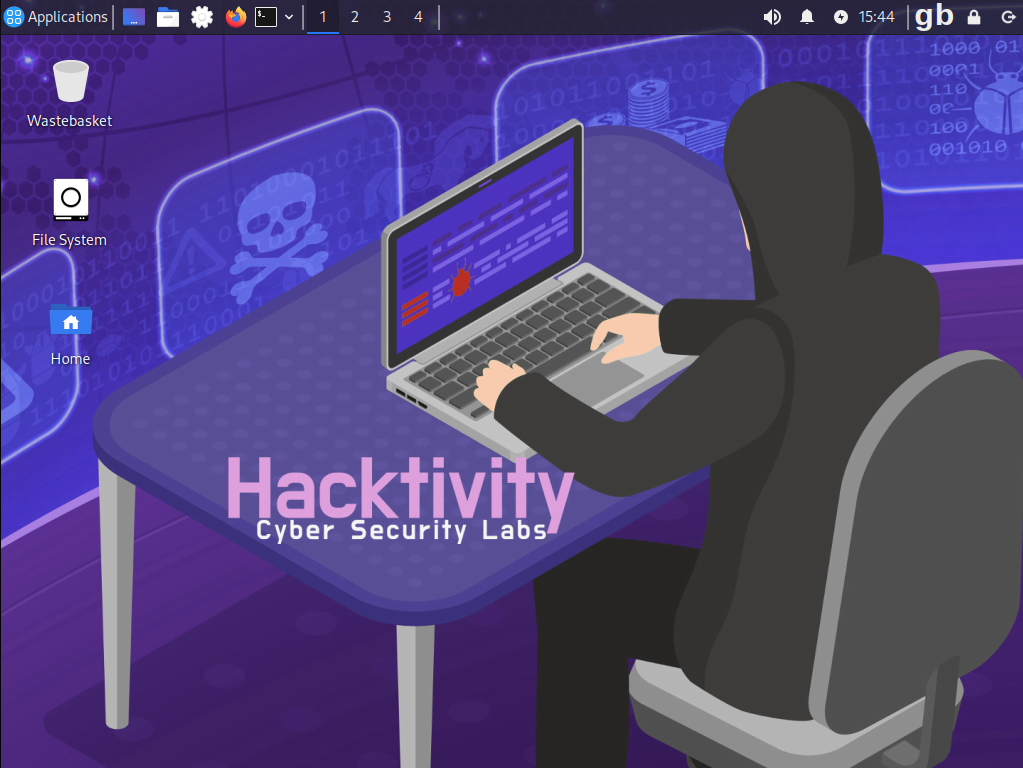 Hacktivity provides remote access via SPICE to Kali Linux VMs, with everything you need pre-installed. Likewise for servers and other desktops.
User Engagement & Gamification
Staying motivated is crucial when learning cyber security. Here's how each platform keeps users engaged:
Hack The Box: Strong competitive elements with global leaderboards and ranking systems. Includes achievement badges and some streak tracking, but primarily focused on competition rather than personal development tracking.
TryHackMe: Good gamification with badges, room completion certificates, streaks, and personal statistics. Leaderboards create healthy competition, though the platform emphasises individual achievement over direct competition.
Immersive Labs: Enterprise-focused with organisational skills dashboards, completion metrics, and team-based leaderboards. Includes achievement badges and progress tracking aimed at organisational reporting.
Hacktivity: Comprehensive engagement system featuring badges for completed labs, weekly streaks with streak counters, calendar flag heatmaps showing activity patterns, and CyBOK knowledge profiles that visualise your developing expertise. Scoreboards and leaderboards for events and separate labs create healthy competition, but with an overall emphasis on personal growth and achievement. Real-time notifications when others solve challenges create a sense of community involvement.
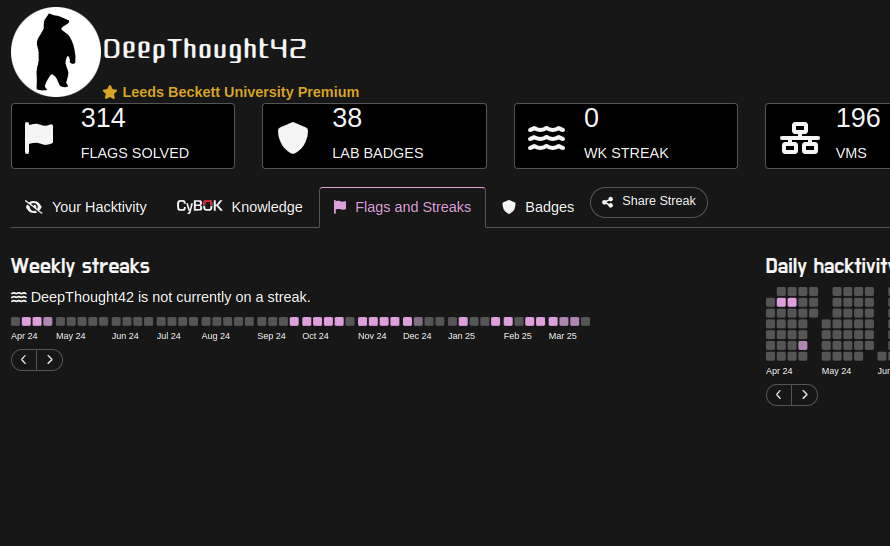 Example of a user profile showing weekly streak counter, and activity heatmaps.
Education Focus & Curriculum Design
The pedagogical approach of each platform reflects its target audience and learning philosophy:
Hack The Box: Self-directed learning with challenging machines. HTB Academy provides more structured content but is separately billed.
TryHackMe: Very beginner-friendly with well-guided learning paths that introduce concepts gradually. Labs focus on accessibility and step-by-step guidance, though depth of coverage can be limited.
Immersive Labs: Enterprise-focused with sophisticated tracking of organisational skills development.
Hacktivity: Designed specifically for education by academics who believe in hands-on learning. The scope of Hacktivity labs is more knowledge-focused than platforms like TryHackMe, with more in-depth lab instructions that emphasise understanding theory before putting it into practice.
Hacktivity is guided by learning pathways (courses) that grow learners from beginners through to technically advanced, industry-ready professionals. Course design is guided by CyBOK, industry consultation and input, while staying hands-on, fun, and applied. While TryHackMe excels at beginner content, Hacktivity builds on foundational knowledge to progress to more advanced understanding—while still being practical and hands-on.
Features include:
- A university-tested curriculum with clear learning pathways
- Timed tests with randomised challenges
- Detailed tracking of student progress
- Automatic marking
- Balance of guided learning and challenging scenarios suitable for both beginners and advanced users
Knowledge Mapping & Skill Tracking
Understanding your progress and identifying skill gaps is essential for effective learning:
Hack The Box Academy: Well-structured content organised by skill level and job roles.
TryHackMe: Clear learning paths organised by topics and difficulty.
Immersive Labs: Skills mapping focused on organisational roles and NIST NICE framework.
Hacktivity: Comprehensive integration with the Cyber Security Body of Knowledge (CyBOK). All content is mapped to this framework, allowing users to visualise their learning journey through personal KXP (Knowledge Experience Points) dashboards that show progress across different knowledge areas. This approach helps identify both strengths and gaps in your cyber security knowledge.
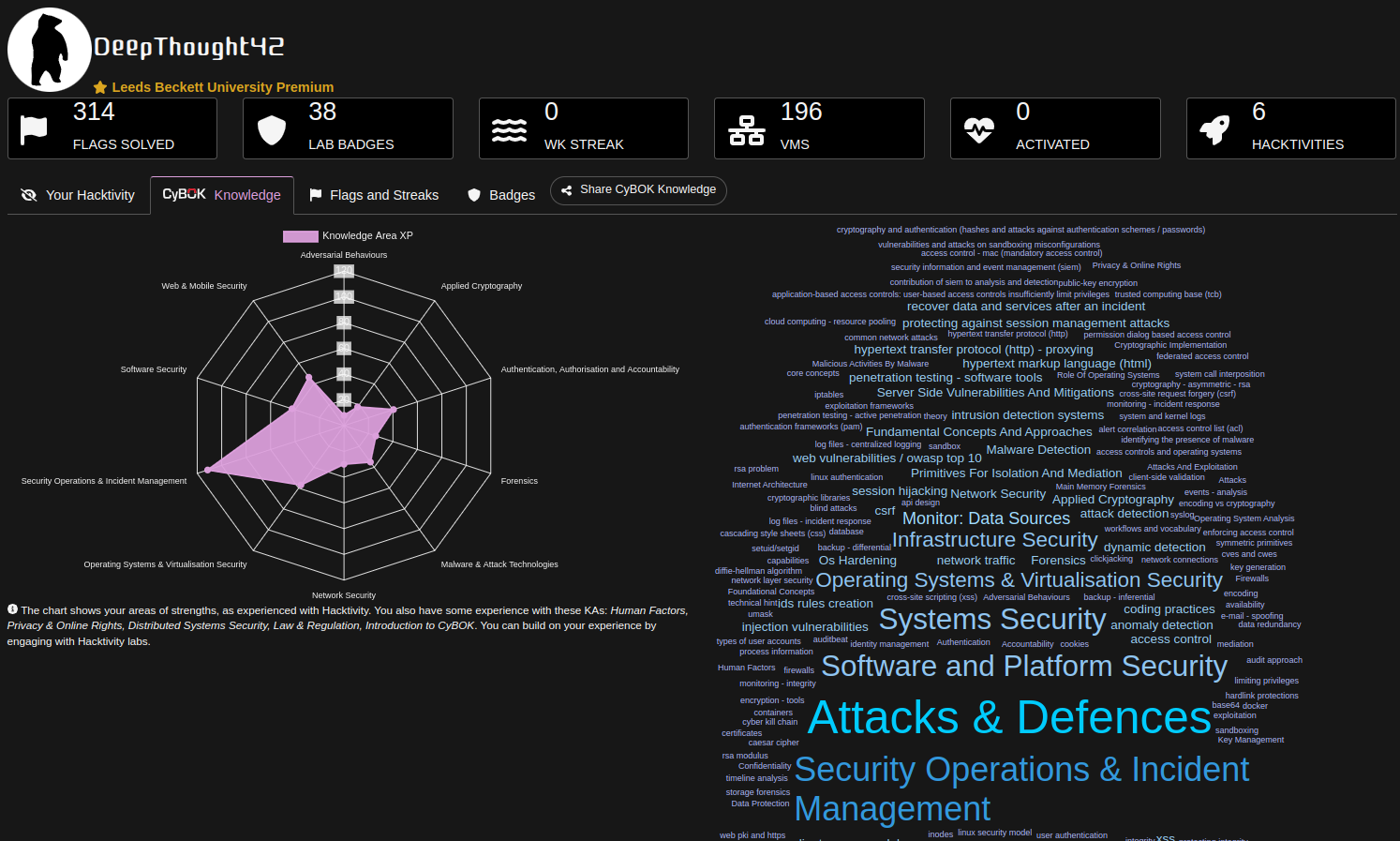 Visualisation of how skills development maps to the Cyber Security Body of Knowledge framework.
Platform Uniqueness & Special Features
Beyond the core functionality, these unique features distinguish each platform:
Hack The Box: Competitive CTF environment with reputation-based ranking system. Extensive machine collection with regular releases.
TryHackMe: User-created rooms complement official content, creating diverse learning options.
Immersive Labs: Crisis simulator for teams to practice incident response.
Hacktivity: Features an interactive chatbot adversary (Hackerbot) that guides students through challenges, verifies task completion, and provides immediate feedback. This creates an engaging and dynamic learning experience, especially for defensive and investigative tasks. Hacktivity also offers Hacktivity Games, a game-based learning experience where genuine technical challenges—real tools against a real Linux VM—sit on the critical path of a branching story that reacts to your choices. Built on the open-source Break Escape engine, it spans beginner-friendly espionage missions through to serious games
exploring the overlap of cyber security and safety, so capturing a flag advances the plot rather than simply scoring points. Hacktivity is built on a foundation of open innovation, with its backend SecGen framework being fully open-source. This commitment to openness enables community collaboration via GitHub and ensures the platform continues to evolve based on educational needs rather than purely commercial interests.
Price Comparison
Value for money is a crucial consideration when choosing a platform. Here's how they compare:
Hack The Box: $25/month or $223/year for VIP+ access to the main platform. (The older, cheaper VIP tier has been retired for new subscribers, with VIP+ now the entry point.)
- What you get: Access to retired machines, unlimited Pwnbox hours, and guided mode.
- What's missing: Does not include Academy content, which requires a separate subscription.
- Value proposition: Good for experienced users who already know what they're doing and don't need much guidance.
Hack The Box Academy: Separate subscription required, and offered under two different models. Cube-based monthly plans (Silver $18, Gold $38, Platinum $68) top up a monthly wallet of cubes
that you spend to permanently unlock individual modules. Access-based annual plans instead grant all-inclusive access up to a difficulty tier: Silver Annual at $490/year (modules up to Tier II, plus an exam voucher) and Gold Annual at $1,260/year (up to Tier III, with more vouchers), alongside a discounted Student plan.
- What you get: Either pay-as-you-go module ownership via cubes, or tier-capped all-access with exam vouchers on the annual plans.
- What's missing: The cheaper tiers cap you at lower-difficulty content—full access to advanced (Tier III) material means the $1,260/year Gold plan. It's also billed entirely separately from the main HTB platform.
- Value proposition: Structured, certification-focused learning, but with a more complex pricing model and a premium price point for complete access.
TryHackMe: Now split into two individual tiers — Premium, covering beginner and intermediate learning paths, and MAX, which adds advanced learning paths, advanced cloud content and full access to all rooms. Premium is ~$11/month billed annually (£9, ~$136/year) or £14.99/month billed monthly; MAX is ~$19/month billed annually (£14.99, ~$227/year) or £24.97/month billed monthly.
- What you get: Access to the rooms and learning paths for your chosen tier, plus unlimited Attack Box usage.
- What's missing: Advanced content is locked behind the pricier MAX tier—unlike Hacktivity, where both plans unlock every course. No randomisation, with solutions widely available online.
- Value proposition: Beginner-friendly guided content, but reaching advanced material means paying up to the higher tier, and challenges remain static with predictable solutions.
Immersive Labs: Enterprise pricing, significantly higher than other platforms (ranging from approximately $2,200 to $3,600 per seat per annum for businesses). Note that Immersive Labs does not publish its pricing publicly, so these figures are indicative estimates based on previously reported numbers rather than current official rates—actual pricing is quote-based via their sales team.
- What you get: Enterprise-grade management features, organisational reporting, and business-focused content.
- What's missing: Prohibitively expensive for individual learners or small teams.
- Value proposition: Tailored to large enterprises with significant training budgets.
Hacktivity: Starting at just $7/month (billed annually at $84) - making it the most affordable option by a significant margin.
- What you get: Complete access to all courses and educational content across all subscription tiers, randomised challenges for unlimited replayability, multi-step CTFs, SPICE desktop experience, and CyBOK skills tracking. Integrated video content and lectures not available on other platforms.
- What you get more of with higher tiers: Additional resources like longer VM run times, more concurrent challenges, and priority access to servers.
- What's growing: As a nimble startup with a dedicated academic team, the platform is continuously expanding its offering of Hack Boxes (open-ended CTFs) and advanced challenges. This smaller team approach means more personalised support and faster response to community feedback.
- Value proposition: Highest value-to-cost ratio, offering university-tested curriculum, advanced features, and complete content access at the lowest price point in the market.
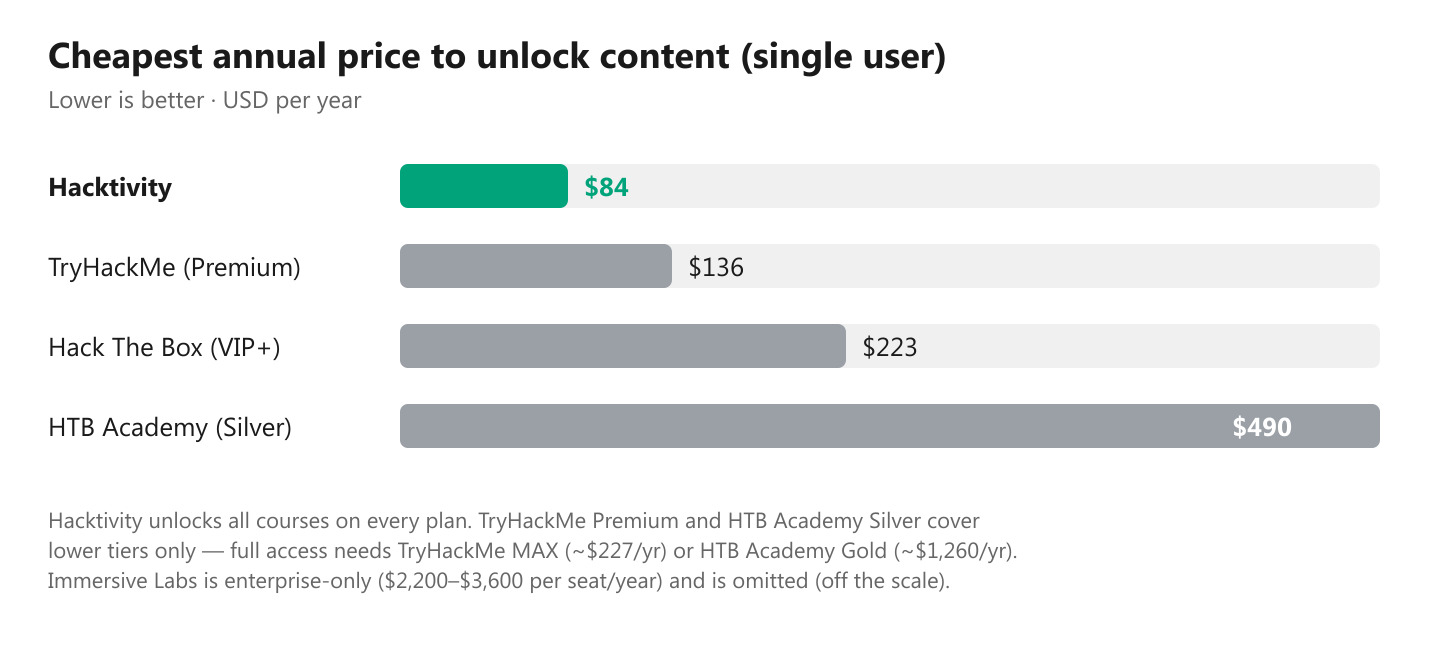 Visual comparison of annual subscription costs across platforms. Comparing the cheapest
 unlock content
option for a single user across each platform.
But the entry price only tells half the story. Because both Hacktivity plans unlock every course, its cheapest plan already includes advanced content—whereas on the other platforms, reaching the advanced tier means stepping up to a much pricier plan. Here's the same comparison for advanced content:
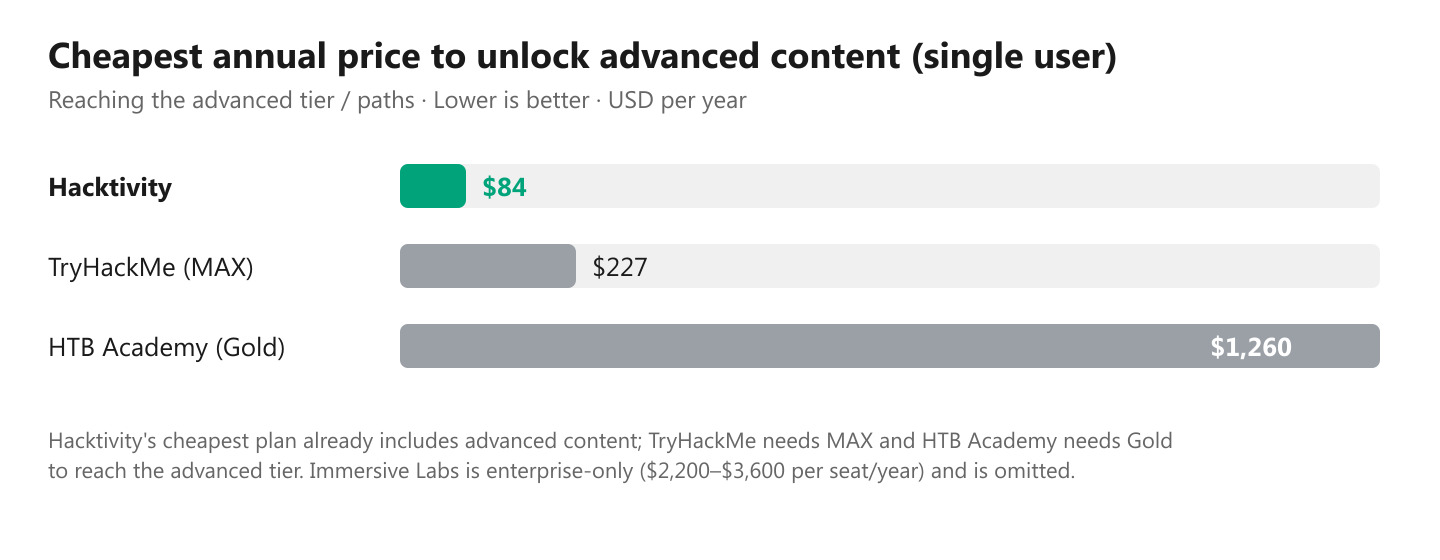 Cheapest annual price to reach advanced content for a single user. All Hacktivity plans unlock every course, including advanced topics, so its cheapest $84 plan already includes them—whereas advanced content elsewhere requires TryHackMe MAX or HTB Academy Gold. Hack The Box's main platform (VIP+) is excluded here as it provides open-ended hacking machines rather than structured learning content.
Business & Education Pricing
Individual subscriptions only tell part of the story. For teams, departments, and institutions, the picture looks like this:
| Platform | Business / Education pricing |
|---|---|
| Hack The Box | An array of business products and plans across the labs, Academy and enterprise platforms. HTB Academy for teams is now quote-based with a minimum of 10 user seats; the enterprise platform is likewise quote-based, with no published per-seat price |
| TryHackMe | Business plan at ~$125 per user per month (£99), or ~$1,500 per user per year (£1,188), on a 12-month term. Education (EDU) licences are $25 per user per month (~$300/year), subject to a $2,000 minimum initial order |
| Immersive Labs | Enterprise pricing, roughly $2,200-$3,600 per seat per year* |
| Hacktivity | Business & Education plan at $480 per user per year (or $40/month), including team management, automated marking, staff access to student VMs, and custom curriculum design. Hacktivity will also price match TryHackMe for educational customers |
*Immersive Labs does not publish per-seat pricing; this range is based on previously reported figures and third-party estimates, and current pricing is quote-based via their sales team, so treat it as indicative only.
Two things stand out. First, several competitors keep business pricing behind a sales conversation—Immersive Labs and Hack The Box's enterprise offering are quote-only, so you can't even budget without contacting them. Second, where prices are published, Hacktivity's $480/user/year undercuts Immersive Labs by a wide margin and is comparable to TryHackMe's education rate—while adding education-specific features such as full randomisation, automated marking and weighting, CyBOK mapping for accreditation, and staff access to student VMs that the others don't match at that price.
Finding Your Perfect Match: Recommendations by User Type
The right platform for you depends largely on your specific needs, goals, and learning style. Here are our recommendations for different user profiles:
For Individual Learners
Hack The Box & Academy: Appeals to self-directed learners who enjoy challenging themselves without much guidance.
TryHackMe: Provides guided content with clear instructions, good for those who prefer step-by-step learning.
Immersive Labs: Primarily aimed at enterprise users rather than individuals.
Hacktivity: Combines the best of both worlds - accessible starting points for beginners with clear guidance, but offering technical depth and challenging scenarios for advanced users. The randomised nature means challenges remain fresh even when repeated, making it ideal for long-term skill development.
For Educational Institutions
Hack The Box: Offers challenging content but limited educational management features.
TryHackMe: Provides some educational features and structured content.
Immersive Labs: Offers organisational management but at premium pricing.
Hacktivity: Purpose-built for education by academics who understand educational needs:
- Automated marking reduces grading burden
- Randomisation prevents solution sharing and cheating
- CyBOK mapping supports accreditation efforts
- Detailed tracking of student progress
- Staff can access student VMs to provide direct assistance
For Businesses
Hack The Box: Provides challenging scenarios for technical team members.
TryHackMe: Offers accessible entry points for staff new to cyber security.
Immersive Labs: Delivers comprehensive organisational management features at premium pricing.
Hacktivity: Offers a cost-effective solution with:
- Comprehensive curriculum covering both offensive and defensive skills
- Thorough progress tracking through CyBOK
- Randomised challenges that test real understanding, not memorisation
- Multi-step CTFs that mirror realistic attack scenarios
Contact us to discuss implementing Hacktivity
Frequently Asked Questions
Q: I'm completely new to cyber security. Which platform should I start with?
A: If you're brand new to cyber security, both TryHackMe and Hacktivity offer beginner-friendly starting points. TryHackMe provides very guided, step-by-step rooms, while Hacktivity offers a more comprehensive curriculum with both guided learning and practical challenges.
Q: Are there free options or alternatives to these paid platforms?
A: All the major platforms offer some form of free tier or way to get started:
- Hack The Box has free challenges but limits access to retired machines and features
- TryHackMe offers free rooms but restricts premium content and Attack Box usage
- Immersive Labs occasionally offers free access through programmes
- Hacktivity lets you try before you buy with a fresh, rotating free tier: when you register for free, one lab from the full course catalogue is unlocked free every month, and it changes each month. This month it's Introduction to Linux and Security from the Ethical Hacking and Penetration Testing course—an excellent starting point—with a different lab featured next month (announced in the newsletter). It means there's always something new to dip into at a steady pace, rather than a fixed set of labs you'd quickly exhaust. Hacktivity also regularly runs promotions, so it's worth checking the pricing page for the current offer before you subscribe—there's often a discount available.
For completely free alternatives, open-source options exist such as SecGen, the framework that powers Hacktivity. However, these typically require the overhead of technical setup, infrastructure, and maintenance compared to hosted platforms.
Q: Do I need to install any special software to use these platforms?
A: For TryHackMe, Immersive Labs, and Hacktivity, you can access most content directly through your browser with no installation—Hacktivity provides zero-install browser (VNC) access to its VMs. Hack The Box requires either setting up a VPN connection or using their browser-based Pwnbox. For the best experience, Hacktivity also offers an optional higher-quality remote desktop via the SPICE protocol, which uses a small viewer application for near-native performance.
Q: How much time should I commit to get value from these platforms?
A: Even just a few hours per week can provide significant value. Many users find that establishing a regular practice schedule (such as 30-60 minutes daily) yields the best results.
Ready to Experience the Difference?
Whether you're a complete beginner just starting your cyber security journey, an experienced professional looking to sharpen your skills, or an educator seeking to provide the best learning experience for your students, there's a platform that matches your needs.
As this comparison shows, Hacktivity offers a unique approach that combines accessibility with depth, guided learning with challenging scenarios, and comprehensive curriculum design with engaging gamification - all at $7/month (billed annually), the most affordable price point in the market and a fraction of what platforms like Hack The Box VIP+ ($223/year) or the higher HTB Academy tiers ($1,260/year) charge.
The best way to judge any platform is to use it. Register for free to try this month's featured lab, then subscribe to unlock every course, lab and challenge and keep your progress, streaks and CyBOK skills profile growing. Check the pricing page before you do—there's often a promotion running that makes an already market-leading price even better:
Pro
For great value access to training and hacking challenges
£7.00
per month (incl. VAT)
£84
billed annually
50% off, ongoing discount!
Features:
✓ Hosted full desktop experience
✓ Randomised personal instances
✓ Hands-on courses and labs designed to take you from beginner to expert
✓ Video explainers and demos
✓ Capture the Flag (CTF) challenges
✓ Hack Boxes
✓ Interactive Hackerbot
✓ Streaks and personal statistics
✓ CyBOK mapping and skills charts
✓ Multi-platform support
✓ Hacktivity Games
Premium
For a premium experience
£15.00
per month (incl. VAT)
£180
billed annually
25% off, ongoing discount!
Features:
All Pro features
✓ Hosted full desktop experience
✓ Randomised personal instances
✓ Hands-on courses and labs designed to take you from beginner to expert
✓ Video explainers and demos
✓ Capture the Flag (CTF) challenges
✓ Hack Boxes
✓ Interactive Hackerbot
✓ Streaks and personal statistics
✓ CyBOK mapping and skills charts
✓ Multi-platform support
✓ Hacktivity Games
Plus Premium features:
✓ No cooldown between challenges
✓ More concurrent challenges
✓ Longer VM run times
✓ Priority access to additional servers
Business & Education
For businesses and educational institutions to run courses for your learners
£40.00
per user/month (excl. tax)
£480.00
billed annually
Features:
All Pro features
✓ Hosted full desktop experience
✓ Randomised personal instances
✓ Hands-on courses and labs designed to take you from beginner to expert
✓ Video explainers and demos
✓ Capture the Flag (CTF) challenges
✓ Hack Boxes
✓ Interactive Hackerbot
✓ Streaks and personal statistics
✓ CyBOK mapping and skills charts
✓ Multi-platform support
✓ Hacktivity Games
All Premium features
Plus Business & Education features:
✓ Transferable seats
✓ Invoicing
✓ Personalised support
✓ An entire curriculum design mapped to CyBOK
✓ Create customised courses
✓ Manage training staff and learner enrollments
✓ Training staff can access learners' VMs
✓ Additional assessments and tests
✓ Set challenge weightings, and download scores
Join the growing community of learners and educators who've discovered a better way to develop cyber security skills.
Hacktivity: Developed in academia, proven in practice, ready for your journey.